
Overview
The Western Maryland Railroad (WM) used former West Virginia Central & Pittsburg Railway (WVC&P) trackage as the backbone of its route through the Allegheny Mountains. Originally built to move coal and timber products from the region, the line quickly became one of the most important railroads serving Cumberland and the Upper Potomac Valley.
The WM modernized and expanded this inherited network, constructing large engine facilities and car yards in Ridgeley, West Virginia. Cumberland soon became a main hub for the WM, serving as the converging point of its two heavy-trafficked main lines.
Origins: The West Virginia Central & Pittsburg Railway
The WVC&P was chartered in 1866 by Henry G. Davis and by 1899 operated a mainline stretching from Cumberland, Maryland to Elkins, West Virginia. As the first railroad to penetrate the Upper Potomac Valley and cross Alleghany Mountains in the region, its construction made it possible for the region’s vast natural resources to reach the eastern markets. The resulting industrial expansion spurred rapid civic growth, with numerous towns and communities developing along the line.
Climbing the Potomac River Valley, driving westward across the Allegany Plateau, and descending the Blackwater River Canyon; the WVC&P undertook some of the most punishing terrain in the region. Heavy grades and numerous river crossings defined the rugged mountain mainline, but purpose-built facilities and yards allowed for commodities to be moved efficiently. The durable and deliberate construction practices of the WVC&P later allowed the Western Maryland Railway to expand seamlessly upon this foundation.
In 1905, the WVC&P underwent reorganization and was merged into the WM. The existing mainline into Cumberland, along with the expansive engine facilities and car yards at Ridgeley, West Virginia positioned the city to be a major operating hub. Building on the solid foundation created by the WVC&P, the WM quickly solidified itself as a major regional railroad with Cumberland serving as the focal point for its two East-West mainlines.
The Western Maryland Era
Following the acquisition of the WVC&P, the Western Maryland Railway wasted no time expanding and upgrading its new trackage throughout the Upper Potomac Valley and surrounding region. The modest engine repair facility and car yard in Ridgeley, West Virginia were transformed into a sprawling complex covering more than 200 acres. The rugged mountain main line was strengthened, expanded, and otherwise improved to accommodate longer and heavier trains, increased traffic, and more efficient operations. These investments showcased the WM’s ambition to become not only a competitive regional carrier, but a major force in the Mid-Atlantic rail network.
At the same time, the WM began construction of the Connellsville Extension, a westward line originating in Cumberland, Maryland and terminating in Connellsville, Pennsylvania. The extension not only opened additional coal and timber resources to the railroad, but also provided access to the steel industries of Johnstown and Pittsburgh through traffic agreements with connecting railroads. These connections allowed Western Maryland freight to reach the Midwest, placing the WM in direct competition with the Pennsylvania Railroad and the B&O.
Track improvements, upgraded bridges, and expanded facilities supported the ever-growing volumes of coal, timber, and general freight moving across both routes. Together, the Connellsville Extension and the newly upgraded Elkins Division established Cumberland as a strategic operating center and set the foundation for the Western Maryland’s growth as a major regional railroad
The WM in Cumberland
Cumberland occupied an important geographic position on the Western Maryland Railway, serving as the meeting point of the Thomas Division and the Connellsville Division. Nestled at the convergence of the Cumberland Narrows and the narrow Potomac River Valley, the city provided a natural operating base where east–west main lines converged, making it an ideal location for terminals, yards, and engine facilities. In 1913, the WM opened a striking passenger station in Cumberland, which also housed the offices for the entire Western Division.
Directly across the Potomac River in Ridgeley, West Virginia, the WM constructed an expansive engine terminal, sprawling classification yards, and numerous support facilities that handled the majority of the railroad’s operations in the region. These facilities allowed trains to be serviced, reclassified, and dispatched efficiently while supporting the heavy coal and freight traffic moving across the mountainous main line. Together, Cumberland and Ridgeley functioned as a single integrated operating complex that kept the WM’s freight moving smoothly across its ever-growing network.
The concentration of infrastructure and intersecting main lines made Cumberland a vital interchange point, with traffic flowing east toward Baltimore, west toward Pennsylvania, and south into West Virginia. This intense level of activity firmly established the city as one of the Western Maryland’s most important operating hubs and a centerpiece of the railroad’s presence in the Upper Potomac Valley.
Traffic and Operations
Coal traffic formed the backbone of Western Maryland operations in the Cumberland area, with loaded trains moving east from the mines of West Virginia and western Maryland toward tidewater markets. Timber, coke, stone, and general merchandise freight supplemented this traffic, creating a steady flow of tonnage across the mountainous main lines converging at Cumberland.
The challenging grades and curvature of the Upper Potomac Valley required careful train handling and well-coordinated operations. Trains were frequently reclassified, serviced, or assisted by helper locomotives at Cumberland and Ridgeley before continuing their journeys across the Allegheny Plateau or descending toward eastern terminals. These operational practices made the area one of the most active and demanding segments of the Western Maryland system.
Cumberland’s position at the junction of multiple main lines and its proximity to major connecting railroads made it a key interchange point. Traffic moved east toward Baltimore, west toward Pennsylvania and Midwest connections, and south into West Virginia, allowing the WM to funnel regional resources into national markets. This complex web of traffic and operations underscored Cumberland’s role as a critical nerve center within the Western Maryland network.
Maps and Infrastructure
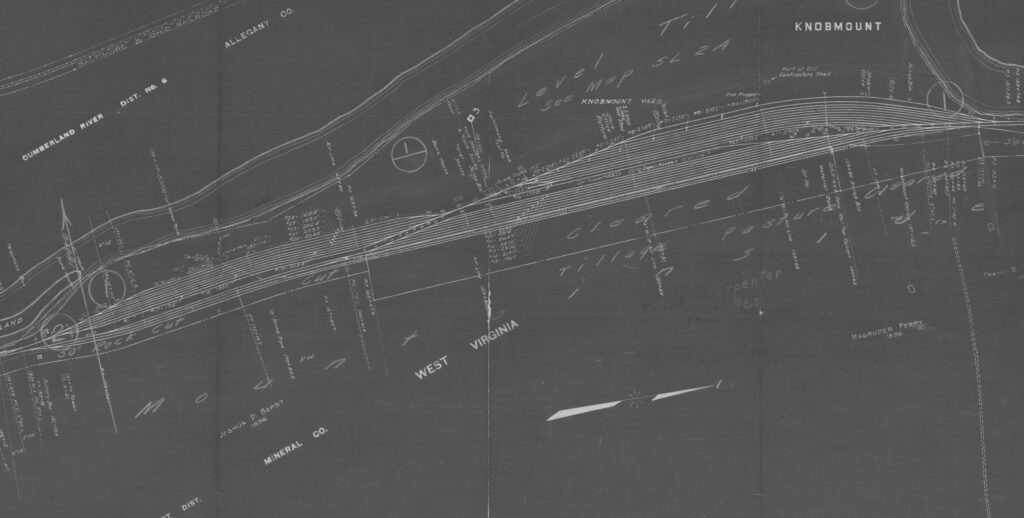
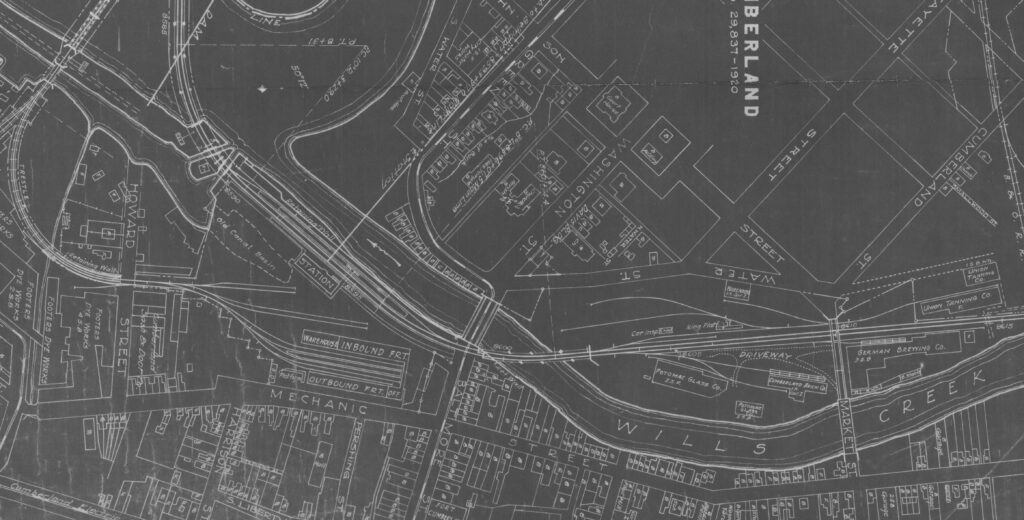
The Western Maryland Railway’s operations in the Cumberland region can be better understood through these historical valuation maps. The first map highlights Knobmount Yard, which served as the primary classification yard for east–west freight traffic in the region. The second map shows the Cumberland Freight Yard and Cumberland Station. The sheer scale of these facilities underscores the importance of Cumberland as a major operating hub on the Western Maryland.
For the complete collection of Western Maryland maps, forms, and images, visit Archives & Documents